
Diagnostics
How We Diagnose Reflux: The Tests Before Treatment
Medically reviewed by Dr. Roger Eduardo, MD, FASMBS, Board-Certified General Surgeon. Last reviewed August 2026.
Book a consultation →Why we test before we treat
Before recommending any anti-reflux procedure, we confirm the diagnosis objectively. Three tests do the work: an upper endoscopy to see the damage, a 24-hour pH study to measure the acid, and esophageal manometry to assess how your esophagus moves. Together they prove the reflux is real, reveal a hiatal hernia or motility problem, guide the choice of procedure, and document the medical necessity insurers require.
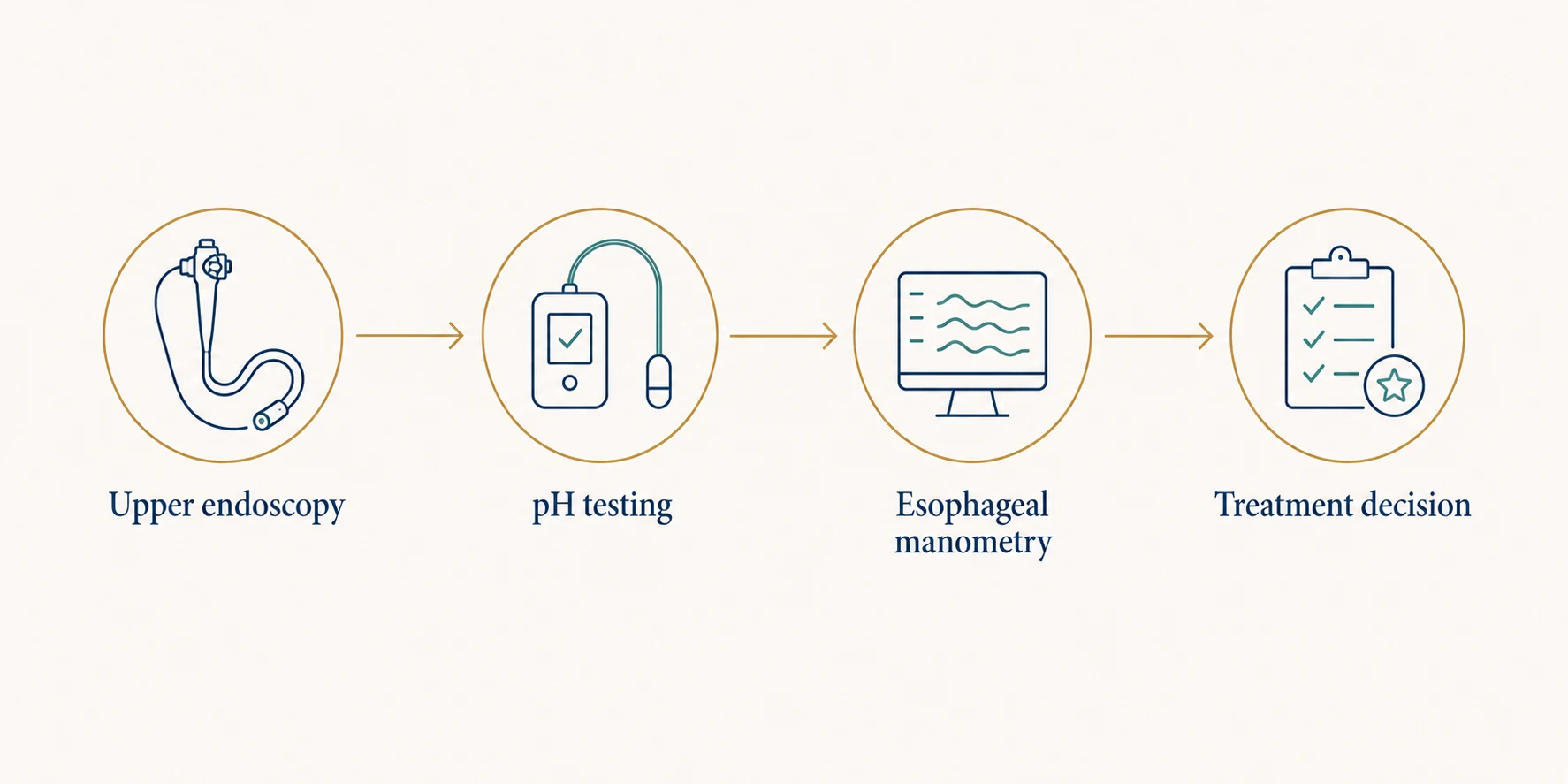
The three-test workup
Three studies, one clear picture
Upper Endoscopy (EGD)
What it is: A thin, flexible camera examines the esophagus and stomach to look for inflammation, a hiatal hernia, strictures, or Barrett's esophagus, and to take biopsies if needed.
Why it matters: Shows the physical damage reflux has caused and rules out other conditions.
24-Hour pH Monitoring
What it is: A small sensor (catheter-based or a wireless Bravo capsule) measures how much acid actually reaches your esophagus over a full day of normal activity.
Why it matters: Objectively confirms GERD and documents medical necessity for surgery and insurance.
Esophageal Manometry
What it is: A thin catheter measures the pressure and coordination of esophageal muscle contractions and the lower esophageal sphincter.
Why it matters: Guides the choice of procedure, for example, a partial (Toupet) wrap when motility is impaired.
A workup that earns your trust
Plenty of clinics either medicate reflux indefinitely or recommend a single procedure they happen to favor. Our approach is different: the testing comes first, and the data drives the recommendation. If surgery isn't the right answer for you, the workup will show that too.
See the procedures the workup informsFAQ
Diagnostics questions
Can't find your answer here? Call us at (470) 742-1832 or book a consultation, we'll answer every question before you commit to anything.
Objective testing protects you. It confirms that your symptoms are truly caused by acid reflux, measures how severe it is, identifies a hiatal hernia or motility problem, and documents medical necessity for insurance. We test before we treat, so the right procedure is chosen for the right reason, not assumed.
An upper endoscopy (EGD) is a visual exam, a camera looks for physical damage like inflammation, hernia or Barrett's esophagus. A pH study measures function, it records how much acid actually reaches the esophagus over 24 hours. They answer different questions, and most surgical candidates need both.
It can. Manometry measures how well your esophagus moves food downward. If motility is impaired, a full 360-degree Nissen wrap may be too tight, and Dr. Eduardo may recommend a partial Toupet wrap or another option instead. This is exactly why we test before deciding on a procedure.
Diagnostic testing for chronic reflux is typically covered by most plans when symptoms warrant evaluation. These same studies also document the medical necessity that insurers require before approving anti-reflux surgery. Our team verifies your coverage in advance.
Start your journey
Get an objective answer about your reflux.
Book a consultation with Dr. Eduardo to begin the workup that finally explains your symptoms.