
Condition
GERD: Symptoms, Causes & When Surgery Helps
For many people, chronic acid reflux does not have to mean medication for life. Here is what GERD actually is, what the pills do and don't do, and the point where repairing the underlying valve becomes the smarter option.

Medically reviewed by Dr. Roger Eduardo, MD, FASMBS, Board-Certified General Surgeon. Last reviewed August 2026.
Book a consultation →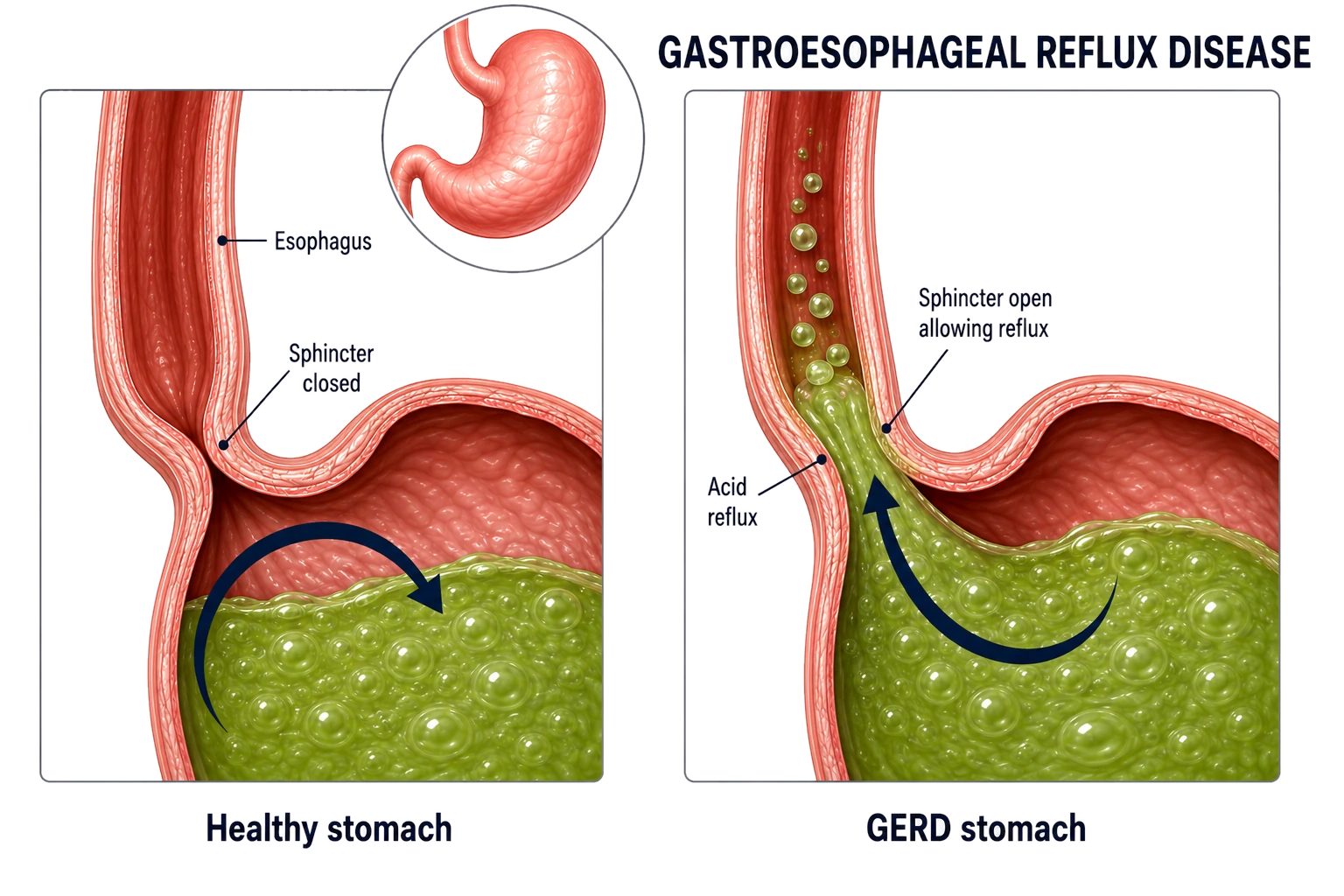
What is GERD?
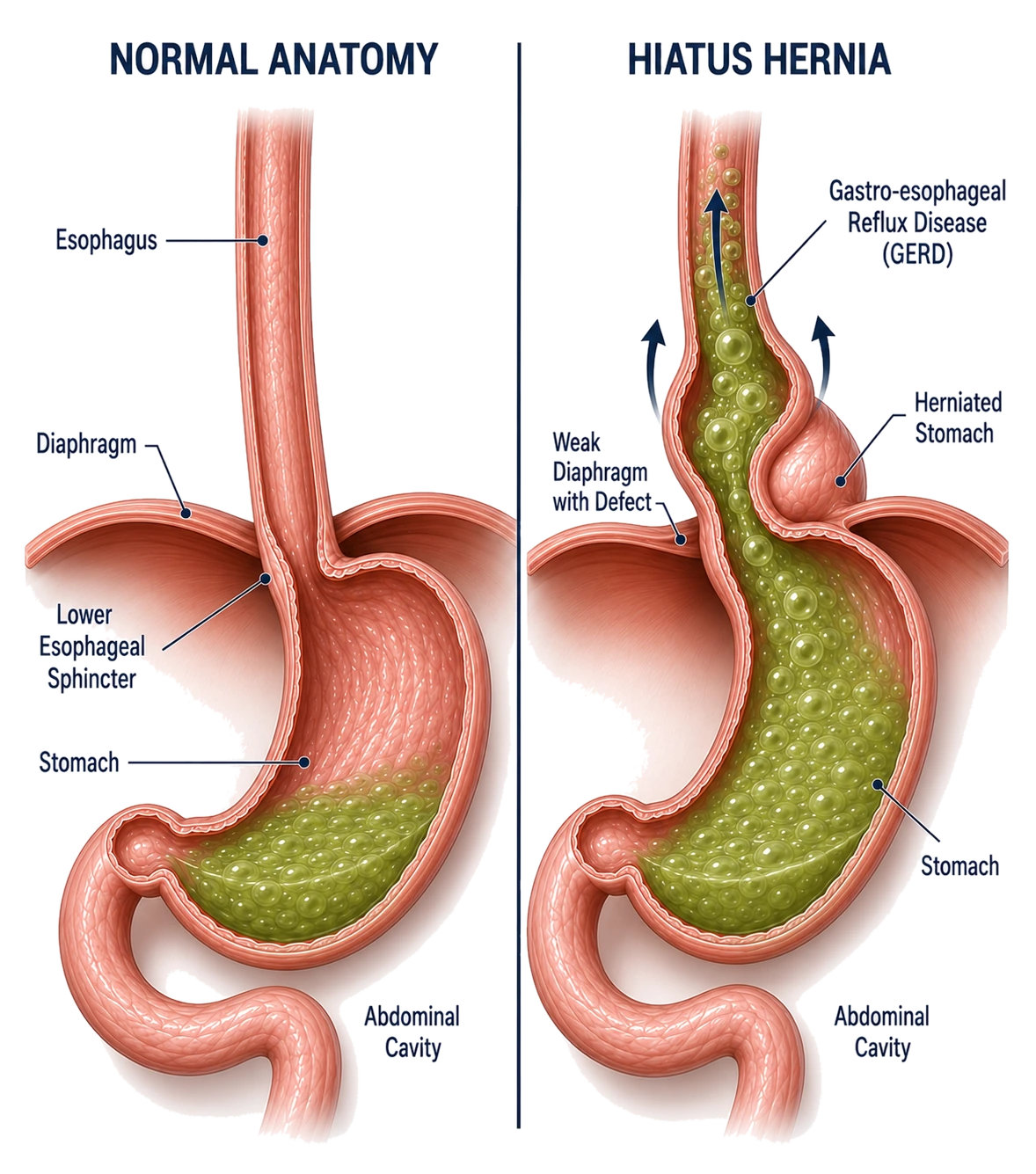
GERD (gastroesophageal reflux disease) is chronic acid reflux: stomach contents flow backward into the esophagus often enough to damage the lining or disrupt your life. It develops when the lower esophageal sphincter, the muscular valve between the stomach and esophagus, weakens or is pulled out of position by a hiatal hernia. Unlike occasional heartburn, GERD is a medical condition that tends to progress when left untreated.
What are the symptoms of GERD?
The classic symptoms are heartburn and regurgitation, a sour or bitter taste as acid and food rise into the throat. But GERD also causes "atypical" symptoms that are easy to miss.
- ◆Typical: heartburn, regurgitation, chest discomfort, a feeling of food sticking.
- ◆Atypical: chronic cough, hoarseness, throat clearing, a lump-in-the-throat sensation, worsening asthma, dental erosion.
- ◆Nighttime: waking with a cough, choking, or a sour taste; symptoms worsened by lying flat.

What causes GERD?
GERD is usually a mechanical problem. The two most common drivers are:
- ◆A weak lower esophageal sphincter (LES): the valve that should stay closed relaxes inappropriately, letting acid escape.
- ◆A hiatal hernia: part of the stomach pushes up through the diaphragm, disrupting the anti-reflux barrier.
Excess weight, pregnancy, smoking and certain foods can worsen reflux, but the underlying valve problem is what surgery addresses.
Severity
The stages of GERD, and the one where you should see a surgeon
Clinicians often describe GERD in four broad stages of severity. The framework is a simplification, and your workup matters more than a label, but it explains why medication is right for some patients and why others keep refluxing on a daily pill.
Stage 1 · Mild
Occasional reflux
Symptoms once or twice a week, usually controlled with lifestyle changes and occasional over-the-counter medication.
Stage 2 · Moderate
Needs daily medication
More frequent symptoms that require regular prescription-strength acid suppression to stay comfortable.
Stage 3 · Severe
Reflux despite medication
Symptoms that break through daily PPIs, or that you would rather not medicate for life. This is the stage where a surgical evaluation is the right conversation.
Stage 4 · Complications
Reflux-induced damage
Long-term reflux has caused strictures, precancerous Barrett's esophagus, or other complications that need surveillance and durable control.
Staging is a general guide, not a diagnosis. Source: Cleveland Clinic. Individual results vary.
How is GERD treated?
GERD treatment follows a ladder, but the top rung is often under-discussed by clinics that only prescribe.
Step 1
Lifestyle
Weight management, smaller meals, avoiding late eating, raising the head of the bed. Helps mild reflux.
Step 2
Medication (PPIs)
Proton-pump inhibitors are highly effective at reducing stomach acid and remain an important, appropriate long-term treatment for many people. What they cannot do is repair a hiatal hernia or restore a disrupted antireflux barrier. The reflux is still ongoing, it just isn't acidic anymore.
Step 3 · The definitive fix
Surgery
Fundoplication, LINX or hiatal hernia repair rebuilds the anti-reflux barrier, the definitive fix when medication isn't enough.

When medication isn't enough
When medication is no longer the right answer
If you've been on daily PPIs for years, still have breakthrough symptoms, or simply don't want to take acid medication for life, you owe yourself an objective evaluation. As a fellowship-trained foregut surgeon, Dr. Eduardo determines (with endoscopy and pH testing) whether a definitive repair is the right next step.
The surgical options
If GERD needs more than medication, here are the surgical fixes
When PPIs stop working or you don't want to take them for life, several proven procedures can rebuild the anti-reflux barrier. The right one depends on your anatomy, the size of any hiatal hernia, and your goals. Dr. Eduardo confirms the diagnosis with endoscopy and pH testing first, then recommends the best fit.
Fundoplication
The long-established standard: the stomach is wrapped to rebuild the valve. Best for severe GERD or a larger hiatal hernia.
Nissen & Toupet 02LINX
A magnetic ring reinforces the valve while preserving normal belching. Best for moderate GERD with suitable anatomy.
Magnetic sphincter augmentation 03TIF
Incisionless fundoplication through the mouth, paired with hiatal hernia repair when needed. No external incisions.
Transoral incisionless fundoplicationFAQ
GERD questions
Can't find your answer here? Call us at (470) 742-1832 or book a consultation, we'll answer every question before you commit to anything.
Heartburn is the burning sensation you feel; acid reflux is the underlying event, stomach acid flowing back into the esophagus; and GERD (gastroesophageal reflux disease) is the chronic condition diagnosed when reflux happens frequently and damages the esophagus or affects quality of life. Occasional heartburn is normal; GERD is reflux that has become a medical problem.
It can be. Beyond the daily discomfort, untreated GERD can cause esophagitis, narrowing (stricture), and Barrett's esophagus, a precancerous change in the esophageal lining. This is why chronic reflux deserves an objective evaluation rather than open-ended self-medication.
Chronic acid exposure can damage the esophagus over time: inflammation (esophagitis), scarring that narrows it (stricture), and Barrett's esophagus, a change in the lining that slightly raises the risk of esophageal cancer. Controlling the reflux, with medication or a definitive repair, is what protects the esophagus. That is why persistent heartburn deserves an objective evaluation rather than years of self-medication.
Barrett's esophagus is a change in the lining of the lower esophagus from long-term acid reflux. It is watched carefully because it can, rarely, progress toward esophageal cancer, but for most people the yearly risk is very low: about 99.7% of people with Barrett's and no cell changes stay cancer-free in a given year (roughly 0.1 to 0.3% annual progression). Regular surveillance endoscopy catches any early change long before it would become cancer, and if a precancerous change is found, endoscopic treatment lowers the risk substantially. The goal is simple: control the reflux and monitor on schedule.
PPIs lower stomach acid, but they don't repair a weak lower esophageal sphincter or a hiatal hernia. If reflux is mechanical (acid and food escaping through a broken valve) reducing acid may not stop regurgitation or nighttime symptoms. When PPIs stop working, it is often a sign the problem is structural and may be surgically correctable.
Medication manages GERD but does not cure it, symptoms typically return when you stop. Anti-reflux surgery, by repairing the valve and any hiatal hernia, addresses the cause and allows most patients to stop or greatly reduce acid medication. Individual results vary, and the right option is confirmed after an objective workup.
Consider a surgical evaluation if PPIs no longer control your symptoms, you don't want to take acid medication for life, you have a known hiatal hernia, or you've developed complications such as Barrett's esophagus. Red-flag symptoms (trouble swallowing, unintended weight loss, vomiting blood, or black stools) warrant prompt medical attention.
Start your journey
Is your GERD more than heartburn?
Book a consultation with Dr. Eduardo for an objective workup and a straight answer about whether surgery can help.