
Procedure · The surgical standard
Nissen & Toupet Fundoplication
Medically reviewed by Dr. Roger Eduardo, MD, FASMBS, Board-Certified General Surgeon. Last reviewed August 2026.
Book a consultation →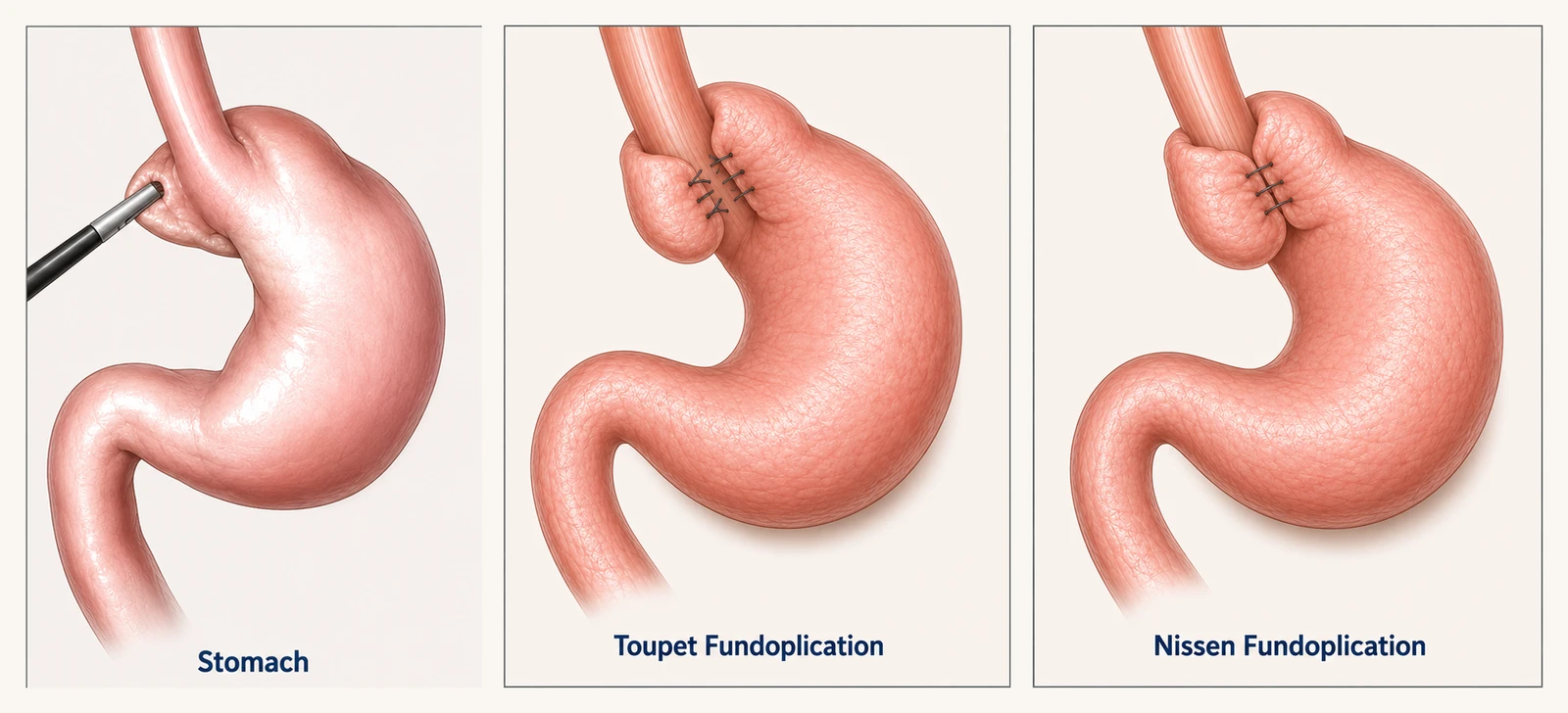
What is fundoplication?
Fundoplication is the long-established surgical fix for GERD. The top of the stomach is wrapped around the lower esophagus to rebuild a one-way anti-reflux valve (fully (a 360-degree Nissen) or partially (a 270-degree Toupet)) almost always alongside repair of any hiatal hernia. With decades of outcome data behind it, fundoplication remains the benchmark against which newer anti-reflux procedures are measured.
How it's performed
Dr. Eduardo performs fundoplication laparoscopically or with da Vinci robotic assistance, through several small incisions. He first repairs any hiatal hernia, returning the stomach to the abdomen and tightening the diaphragm, then wraps the fundus around the lower esophagus and secures it to recreate the valve.
Nissen vs. Toupet
The choice between a full and partial wrap is a clinical decision based on your esophageal motility (measured by manometry) and anatomy. A Toupet partial wrap is often preferred when motility is impaired or to lower the risk of post-operative swallowing difficulty; a Nissen full wrap offers the most robust reflux control. Dr. Eduardo discusses the trade-offs with you before surgery.
Who's a candidate?
Fundoplication suits patients with chronic GERD, especially severe reflux, a sizable hiatal hernia, or those who can't or don't want to stay on lifelong PPIs. It's confirmed appropriate after an objective workup. See the workup
Expected results
Fundoplication reliably controls reflux, and most patients stop or greatly reduce daily acid medication afterward. Clinical studies report 80–90% PPI cessation or significant reduction at 1 year, with durable results at 5+ years (Kellokumpu et al.; Dallemagne et al.). Individual results vary and depend on anatomy and follow-up.
Risks & considerations
Risks include bleeding, infection and anesthesia reactions, plus procedure-specific effects: temporary difficulty swallowing, gas-bloat syndrome, and reduced ability to belch or vomit (more common with a full Nissen). Serious complications are uncommon at experienced centers.
Recovery
Most patients go home after an overnight stay and return to normal activity within one to two weeks. A staged soft-food diet eases the first few weeks while swelling settles.
Insurance
Usually covered when medically necessary. Verify coverage
Cost
Transparent self-pay pricing, explained before you commit. Financing
Compare
Fundoplication vs. LINX. See LINX
Dr. Eduardo's approach
Fellowship-trained foregut surgery
As a fellowship-trained, board-certified surgeon, Dr. Eduardo performs fundoplication with advanced laparoscopic and da Vinci robotic technique, tailoring the wrap (Nissen vs. Toupet) to your manometry and anatomy, and repairing any hiatal hernia in the same operation. Fix the cause, not just the symptom.
FAQ
Fundoplication FAQ
Can't find your answer here? Call us at (470) 742-1832 or book a consultation, we'll answer every question before you commit to anything.
Fundoplication is anti-reflux surgery in which the top of the stomach (the fundus) is wrapped around the lower esophagus to rebuild a one-way valve. A Nissen is a full 360-degree wrap; a Toupet is a partial 270-degree wrap. Both are typically combined with hiatal hernia repair and are the long-established surgical standard for GERD.
A Nissen wraps the stomach fully around the esophagus (360 degrees) for the strongest anti-reflux barrier. A Toupet is a partial wrap (270 degrees) that provides robust reflux control while leaving more room for the esophagus to function, often preferred for patients with impaired esophageal motility or a higher risk of post-operative swallowing difficulty. Dr. Eduardo chooses based on your manometry results and anatomy.
Fundoplication is highly effective at controlling reflux, and most patients are able to stop or greatly reduce daily acid medication afterward. Clinical studies report 80–90% PPI cessation or significant reduction at 1 year, with durable results at 5+ years. Individual results vary by patient and anatomy.
Most patients go home after an overnight stay and return to normal activity in roughly one to two weeks. You'll follow a staged diet (liquids, then soft foods) for the first few weeks while swelling settles. Some patients notice temporary difficulty swallowing or increased gas/bloating that improves over time.
As with any surgery, risks include bleeding, infection and reactions to anesthesia. Procedure-specific effects can include difficulty swallowing (usually temporary), gas-bloat syndrome, and an inability to belch or vomit normally (more common with a full Nissen wrap). Serious complications are uncommon at experienced centers. Dr. Eduardo reviews your individual risk profile beforehand.
Yes. While fundoplication is intended to be durable, a wrap can loosen or, less often, become too tight over time. Revisional anti-reflux surgery is possible, and Dr. Eduardo's foregut surgical training includes redo procedures. The need for revision is uncommon and discussed individually.
Start your journey
Is fundoplication right for you?
Book a consultation with Dr. Eduardo for an objective workup and a straight recommendation.