
Condition · Bariatric & foregut
Reflux After a Gastric Sleeve: Why It Happens, and What Actually Fixes It
Medically reviewed by Dr. Roger Eduardo, MD, FASMBS, Board-Certified General Surgeon. Last reviewed August 2026.
Book a consultation →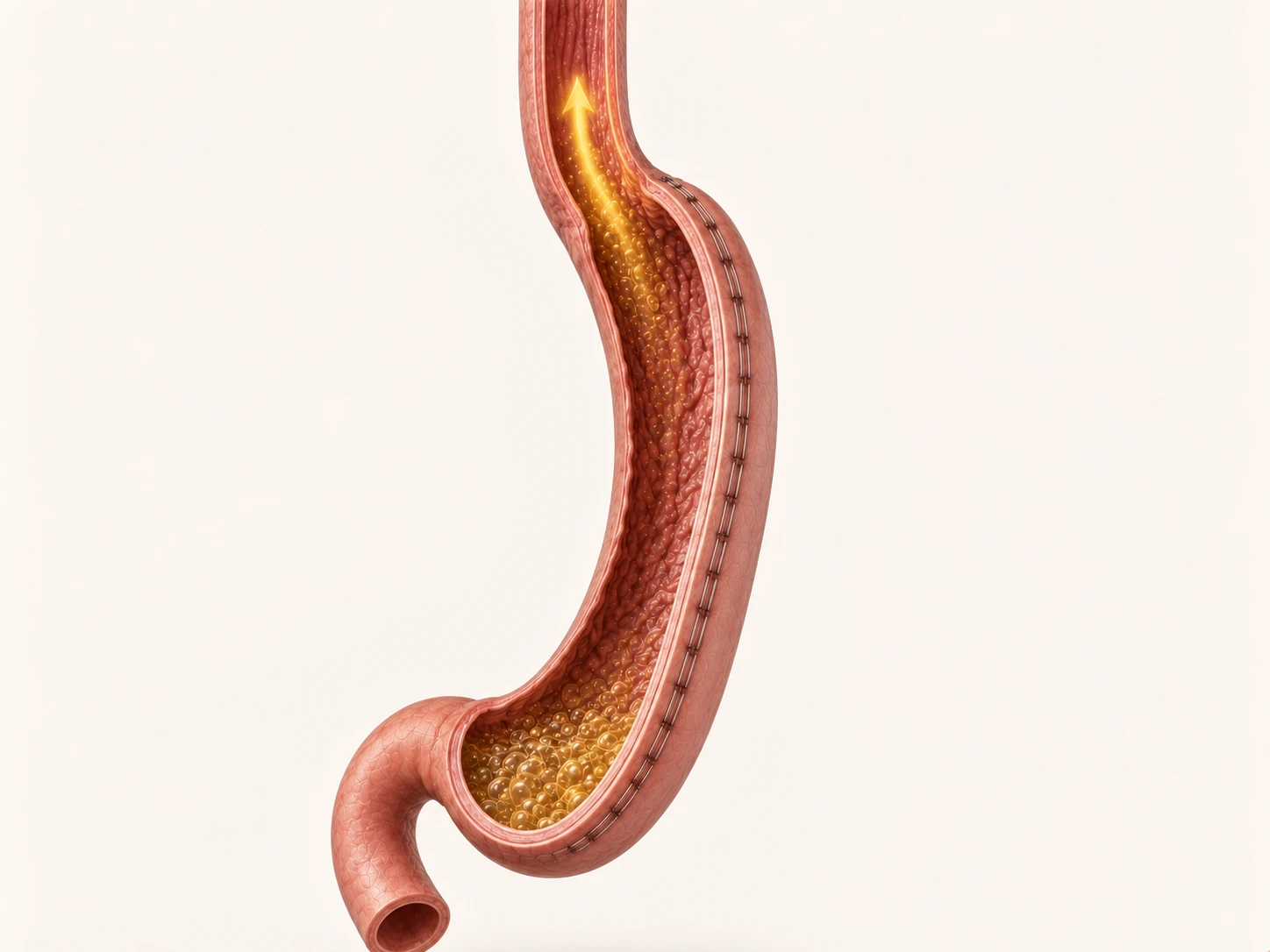
New reflux after a sleeve is common, and it is fixable
You had a sleeve, you lost the weight, and now you cannot sleep flat. Or the reflux you had before surgery, the reflux everyone said would improve once you lost weight, got worse instead. This is one of the most common reasons patients come to see Dr. Eduardo, and it is usually presented to them as bad luck. It is not bad luck. It is anatomy, it is predictable, and there is a specific order in which it should be worked up and treated. New or worsening reflux after a gastric sleeve is common, mechanical, and, in the right hands, correctable.
How common is it, really?
Common enough that it should be part of the consent conversation before a sleeve, not a surprise after it.
- ◆Among patients with no reflux before a sleeve, roughly 10 to 15% develop new reflux afterward, and about 2% ultimately need revisional surgery for it.
- ◆Across long-term studies, reflux symptoms, erosive esophagitis, hiatal hernia and PPI use all rise roughly two to three-and-a-half fold.
- ◆Barrett's esophagus risk is real and rises with time since surgery. Anyone quoting a single confident figure is overstating an inconsistent literature.
Why the operation causes it
A sleeve removes roughly 80% of the stomach, including the fundus, and changes several things at once at the junction of esophagus and stomach.
- ◆The angle of His, the flap valve where the esophagus meets the stomach, is flattened when the fundus is removed.
- ◆The sling fibers that help the lower esophageal sphincter cinch closed are divided during the resection.
- ◆Pressure inside the narrow remaining stomach rises and pushes contents upward.
- ◆A hiatal hernia, missed or newly developed, lets the gastric tube slide into the chest and defeats what valve remains.
Most of these are structural. That is why the acid so often does not respond fully to medication: you cannot medicate an anatomic defect into behaving.
Why a fundoplication is not an option, and what replaces it
For reflux in someone who has never had bariatric surgery, a Nissen or Toupet fundoplication is the durable surgical answer: the surgeon wraps the top of the stomach around the lower esophagus to rebuild the valve.
After a sleeve, that operation is not possible. The fundus, the part of the stomach used to build the wrap, is exactly what was removed and sent to pathology. There is no tissue to wrap. Any clinic offering you a fundoplication after a sleeve has not understood your anatomy.
The standard definitive answer is conversion to a Roux-en-Y gastric bypass, which takes acid out of the equation by rerouting the anatomy rather than rebuilding a valve, and usually helps with any weight regain. In comparative series, conversion to Roux-en-Y resolved reflux in about 92% of patients. Reflux is the stated reason for about 30% of all sleeve-to-bypass conversions, so this is a well-travelled path, not an exotic one. For the narrower group with a normal BMI who do not want or need a bypass, magnetic sphincter augmentation (LINX) is a considered option. Results are good but not perfect, revisional surgery carries more risk than a first operation, and individual results vary.
The right order of workup
A lot of care goes sideways here, usually by jumping from symptoms straight to a proposed operation, or by leaving a patient on a PPI for years without ever looking. The sequence that makes sense is unglamorous.
Step 1
A fair trial of acid suppression
Many patients are adequately controlled and need nothing further, just surveillance. Medication is tried honestly before surgery is discussed.
Step 2
The full picture, if symptoms persist
Upper endoscopy with biopsies, pH testing off medication, esophageal manometry, and a contrast study of the sleeve. Manometry is not box-checking, it decides what operation is safe to offer. See the workup
Step 3 · The definitive fix
The operation the results point to
A hiatal hernia repair, or a conversion to gastric bypass, whichever the testing actually indicates, never a fundoplication.
One surgeon, not two
Why this problem needs one surgeon who does both
Reflux after a sleeve sits exactly on the line between two specialties. Most bariatric surgeons do not do complex antireflux work, and most foregut surgeons do not do revisional bariatric surgery, so patients get passed back and forth while the acid keeps working on their esophagus.
Dr. Roger Eduardo is board-certified and fellowship-trained at Cleveland Clinic Florida in both. He performs the sleeves and bypasses, and he performs the antireflux and hiatal hernia operations, which means one person can order the right workup, read it, and do whichever operation the results actually point to. That is the whole argument, and it is why this page exists. It is care you can get here in Newnan, serving Coweta and Fayette County, without being handed off between practices.
Insurance and cost
When reflux and its complications are documented by objective testing, evaluation and revisional anti-reflux surgery are often covered by commercial and Medicare plans. Coverage depends on your plan, so our team verifies your benefits and handles pre-authorization before anything is scheduled. For patients without coverage, self-pay pricing is quoted in writing on request. Verify your coverage
FAQ
Reflux after gastric sleeve: FAQ
Can't find your answer here? Call us at (470) 742-1832 or book a consultation, we'll answer every question before you commit to anything.
It is a real and well-recognized risk, and more common than many patients are told. Among people who had no reflux before a sleeve, roughly 10 to 15% develop new reflux symptoms afterward, and about 2% ultimately need revisional surgery for it. It should be part of the consent conversation before a sleeve, not a surprise after it. It is not bad luck, it is predictable anatomy, and there is a specific order in which it should be worked up and treated.
A sleeve removes roughly 80% of the stomach, including the fundus, and that changes the anatomy at the junction of the esophagus and stomach. The angle of His that acts as a flap valve is flattened, the sling fibers that help the lower esophageal sphincter close are divided, and pressure inside the narrow remaining stomach rises and pushes contents upward. A hiatal hernia, whether missed at the original operation or developed since, makes it worse. Most of these are structural, which is why the acid so often does not respond fully to medication.
No. A Nissen or Toupet fundoplication rebuilds the valve by wrapping the fundus around the lower esophagus, and the fundus is precisely the part of the stomach a sleeve removes. There is no tissue to wrap. Any clinic offering you a fundoplication after a sleeve has not understood your anatomy. The definitive surgical answer is usually conversion to a Roux-en-Y gastric bypass, with magnetic sphincter augmentation considered in selected normal-BMI cases.
Testing comes first. Many patients are controlled on acid suppression and need only surveillance. When symptoms are refractory, the workup is an upper endoscopy with biopsies, pH testing off medication, esophageal manometry, and a contrast study of the sleeve. If a hiatal hernia is present it is repaired, which resolves a meaningful share of cases. When a durable fix is needed, conversion to a Roux-en-Y gastric bypass resolves reflux in about 92% of patients in comparative series. Results are good but not perfect, revisional surgery carries more risk than a first operation, and individual results vary.
Probably yes. ASMBS recommends a screening endoscopy in all patients three or more years after a sleeve, whether or not they have symptoms, and roughly every five years after if the first is normal. This is widely unmet. Chronic acid exposure can change the lining of the lower esophagus (Barrett's esophagus) quietly, so if you are several years out from a sleeve and have never had a scope, you are the patient that recommendation was written for. Bring your prior operative report if you have it.
Start your journey
Reflux after a gastric sleeve? One surgeon can evaluate and fix it.
Book a consultation with Dr. Eduardo, both bariatric and foregut trained, for the right workup and an honest plan. Bring your prior operative report if you have it. Call to schedule: (470) 742-1832.