
Procedure · A two-specialist team
TIF + Hiatal Hernia Repair: A Staged Reflux Pathway
Medically reviewed by Dr. Roger Eduardo, MD, FASMBS, Board-Certified General Surgeon. Last reviewed August 2026.
Book a consultation →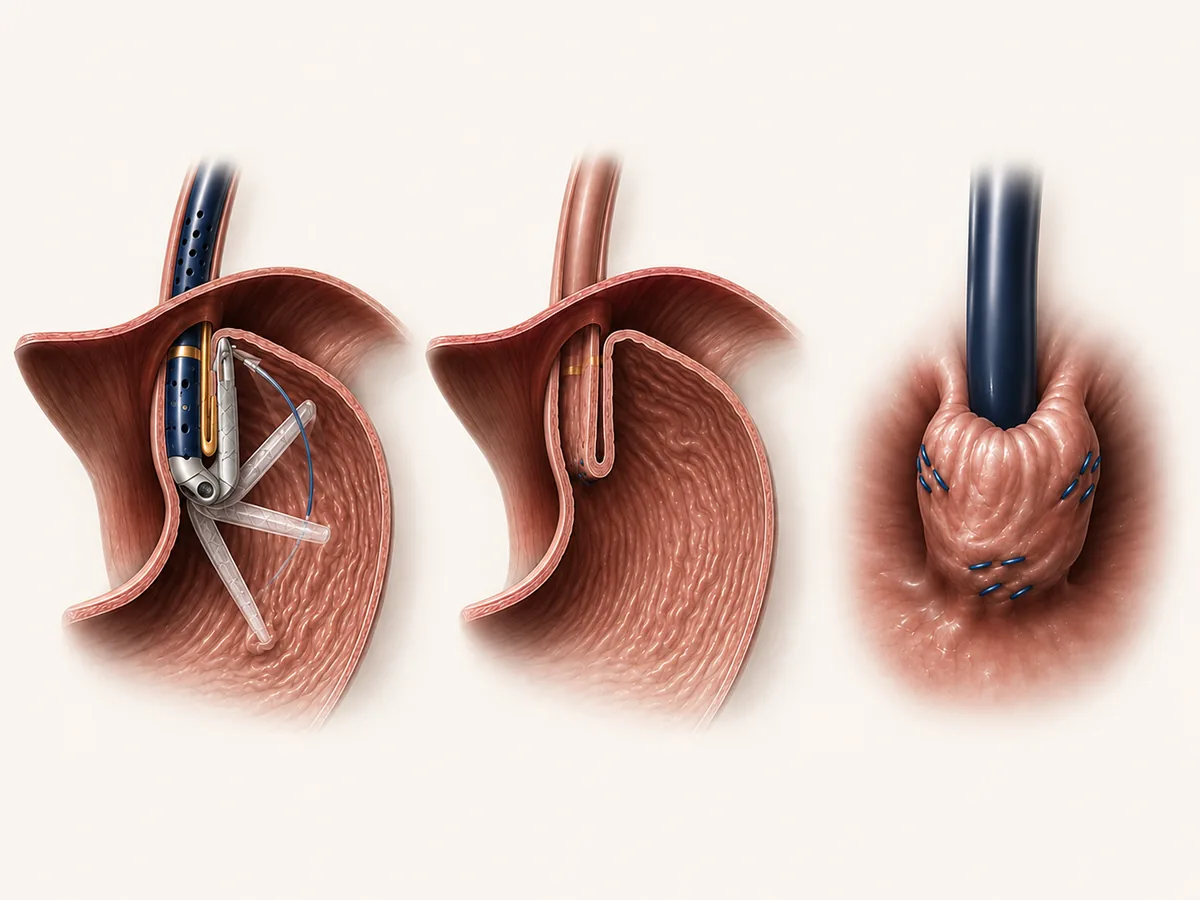
What is TIF?
TIF (transoral incisionless fundoplication) rebuilds the anti-reflux valve from inside the stomach using a device passed through the mouth, with no abdominal incisions. It offers a scar-free, quick-recovery option for selected GERD patients. Its main limitation: TIF alone does not repair a hiatal hernia. That's exactly the gap Omnia Health's staged pathway is built to close: the hernia repair first, the TIF second.
The Omnia difference
Two specialists, one coordinated plan
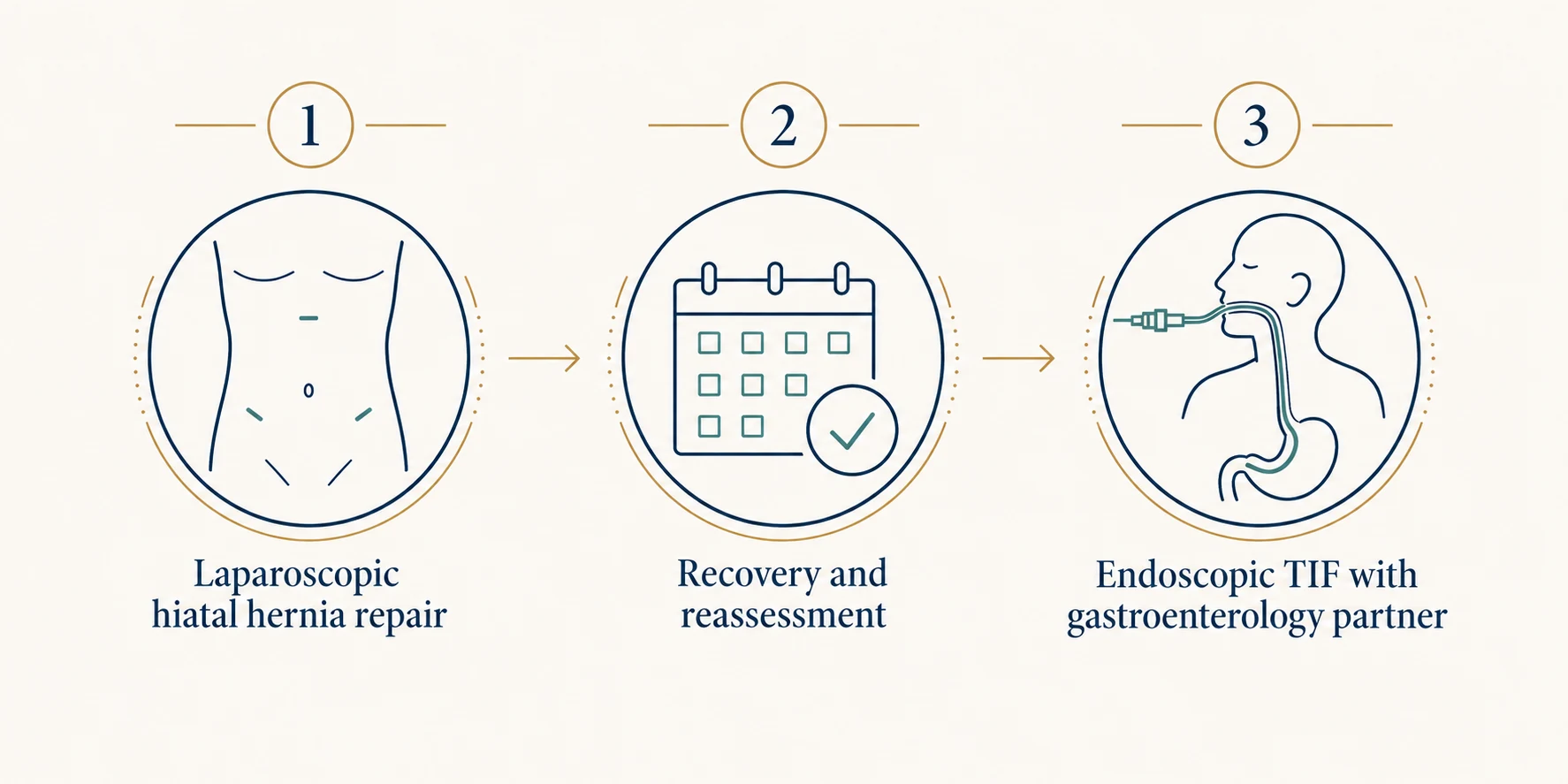
A TIF rebuilds the valve, but it cannot move a hiatal hernia. So the two problems are treated by the two specialists trained for them. Dr. Eduardo repairs the hiatal hernia laparoscopically, and a gastroenterology group he works closely with performs the incisionless TIF as a coordinated second step. Two procedures, one plan, and one surgeon who stays responsible for the whole picture.
Dr. Eduardo (foregut surgeon)
Repairs the hiatal hernia laparoscopically, restoring the anatomy that a TIF alone cannot address. This step comes first.
Our gastroenterology partners
Perform the transoral incisionless fundoplication endoscopically, rebuilding the valve from inside, through the mouth, with no incisions.
How it's performed
If you have a hiatal hernia, Dr. Eduardo repairs it first, laparoscopically, through a few small incisions. The TIF then follows as a separate, coordinated procedure with our gastroenterology partners, who rebuild the valve endoscopically through the mouth with no incisions at all. For patients without a hiatal hernia, the TIF may be done on its own.
Who's a candidate?
TIF suits selected patients with objectively documented GERD, especially those seeking an incisionless or less invasive option. Candidacy depends on anatomy and hernia size, confirmed after the workup. See the workup
Expected results
In the TEMPO trial, 46% of patients had completely stopped PPIs at 5 years and a further 20% used them only occasionally; troublesome regurgitation was eliminated in 86%, and 5% needed a subsequent operation (Trad et al., Surg Innov 2018). These results are from patients treated with TIF. Patients who need a hiatal hernia repair first follow a staged pathway, and expected outcomes are discussed individually. Individual results vary.
Recovery
TIF alone is quick, often back to activity within days. If a hernia repair is needed first, recovery from that step is slightly longer due to the small incisions, but still faster than open surgery. A staged diet is followed at first.
Risks
Risks include the general risks of anesthesia and endoscopy, temporary swallowing difficulty, and (uncommonly) the need for further surgery. The team reviews your individual risk profile beforehand.
Insurance
Often covered when medically necessary. Verify coverage
Cost
Transparent self-pay pricing, explained before you commit. Financing
Compare
TIF vs. fundoplication vs. LINX. All procedures
Weighing your options
Other anti-reflux procedures
FAQ
TIF FAQ
Can't find your answer here? Call us at (470) 742-1832 or book a consultation, we'll answer every question before you commit to anything.
TIF stands for transoral incisionless fundoplication. Using a device passed through the mouth, the surgeon rebuilds an anti-reflux valve at the top of the stomach from the inside, with no abdominal incisions. It's intended for selected patients with GERD and limited or no hiatal hernia, offering a faster, scar-free recovery compared with traditional surgery.
Many patients with reflux also have a hiatal hernia, which TIF alone cannot fully address. Omnia handles that in two coordinated steps rather than one: Dr. Eduardo repairs the hiatal hernia laparoscopically, restoring the anatomy, and a gastroenterology group he works closely with performs the incisionless TIF afterwards. Each part is done by the specialist best trained for it, and your care is coordinated between them rather than handed off.
cTIF (concomitant TIF) means the hiatal hernia repair and the TIF are done in the same operation. The pairing matters because the hernia repair restores the anatomy while the TIF rebuilds the valve, which extends the TIF option to patients a TIF alone would not help. At Omnia the same two parts are done, but as two staged procedures rather than in one session: Dr. Eduardo performs the hernia repair, and the TIF follows with our gastroenterology partners.
TIF is considered for selected patients with objectively documented GERD, often those who don't want a traditional wrap or who have early-to-moderate disease. Candidacy depends on your anatomy (including the size of any hiatal hernia) and is confirmed after upper endoscopy, pH monitoring and manometry. Dr. Eduardo, together with our gastroenterology partners, will tell you whether a TIF pathway, a fundoplication, or another option fits you.
Because TIF is incisionless, recovery is typically quick, many patients return to normal activity within days, following a staged diet at first. If you need a hiatal hernia repair first, recovery from that step is a little longer because of the small abdominal incisions, but still faster than open surgery.
Start your journey
Is an incisionless approach right for you?
Book a consultation to find out whether a TIF pathway fits your reflux, and whether a hiatal hernia repair needs to come first.