
Procedure · Coming soon
LINX: A Magnetic Implant That Stops Reflux
Medically reviewed by Dr. Roger Eduardo, MD, FASMBS, Board-Certified General Surgeon. Last reviewed August 2026.
Book a consultation →Soon to be offered at Omnia Health
LINX will join fundoplication and hiatal hernia repair at Omnia Health, giving patients a full range of surgical anti-reflux options. It is not yet available here. If your workup points toward LINX, Dr. Eduardo will tell you where things stand and what your options are in the meantime. Candidacy is always confirmed after an objective workup.
What is LINX?
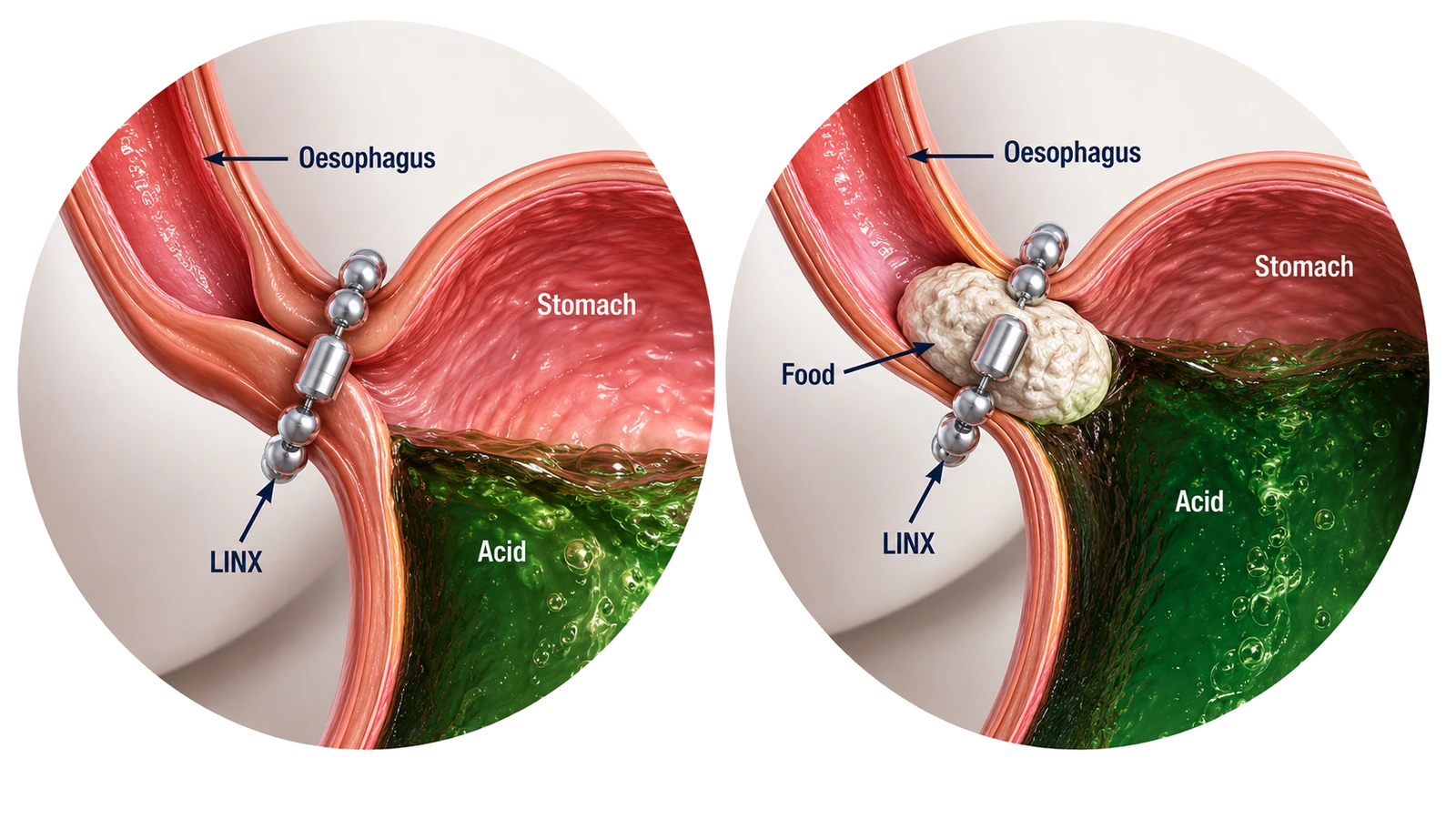
LINX is a small, flexible ring of magnetic titanium beads placed around the lower esophageal sphincter. The magnetic attraction keeps the weakened valve closed against reflux, while still separating to let food pass when you swallow, and to let you belch and vomit normally. Because it augments your own anatomy rather than reconstructing the stomach, LINX is minimally invasive and designed to be removable.
How it's performed
LINX is placed laparoscopically, through several small incisions, usually as an outpatient or overnight procedure. The device is sized to your anatomy and positioned around the lower esophageal sphincter; any hiatal hernia is repaired at the same time. The operation is typically shorter than a fundoplication.
How it controls reflux
At rest, the magnetic beads gently hold the valve closed so acid can't escape. When you swallow, the pressure of food pulls the beads apart so it passes normally; they then close again. The design intentionally preserves your ability to belch and to vomit if you need to, a key difference from a full fundoplication wrap.
Who's a candidate?
LINX suits patients with moderate, objectively documented GERD who want to preserve normal belching and vomiting and who don't have a very large hiatal hernia or severely impaired motility. Candidacy is confirmed after an objective workup. See the workup
Expected results
About 8 in 10 patients are off daily acid medication after LINX, and that holds at five years and beyond. The device is designed to stop reflux while preserving your ability to belch and vomit normally. Individual results vary.
The data behind that number
In the CALIBER randomized trial, 91% of patients had stopped PPIs at six months against 10% on twice-daily PPI therapy, and moderate-to-severe regurgitation resolved in 89% (Bell et al., Gastrointest Endosc 2019). Pooled long-term series run closer to 85%. We quote 80% because that is the figure that still holds at five years and beyond. About 4 in 100 patients eventually have the device removed, most often for persistent difficulty swallowing, and erosion of the device into the esophagus is rare, roughly 2 in 1,000.
Risks & considerations
Risks include the general risks of surgery plus device-specific considerations: difficulty swallowing (often temporary), and uncommonly, the need to remove the device. MRI compatibility is generally up to a specified scanner strength, carry your device card and tell imaging staff.
Recovery
Most patients return to normal activity in about a week. Unlike fundoplication, you're usually encouraged to resume a regular diet soon after surgery to keep the device moving smoothly.
Insurance
Often covered when medically necessary. Verify coverage
Cost
Transparent self-pay pricing, explained before you commit. Financing
Compare
LINX vs. fundoplication. See fundoplication
Dr. Eduardo's approach
An expanding anti-reflux toolkit
Dr. Eduardo is broadening the practice's anti-reflux options so the procedure can be matched to the patient, not the other way around. He'll walk you through whether LINX, a fundoplication, or another approach best fits your anatomy and goals after an objective workup.
Weighing your options
Other anti-reflux procedures
FAQ
LINX FAQ
Can't find your answer here? Call us at (470) 742-1832 or book a consultation, we'll answer every question before you commit to anything.
LINX is a small, flexible ring of titanium beads with magnetic cores, placed around the lower esophageal sphincter during a minimally invasive operation. The magnets keep the weak valve closed against reflux, yet open temporarily to let food pass when you swallow, and to let you belch or vomit normally. It augments your own anatomy rather than reconstructing it.
Both rebuild the anti-reflux barrier, but differently. Fundoplication wraps the stomach around the esophagus; LINX places a magnetic ring around it without altering stomach anatomy. LINX is designed to preserve the ability to belch and vomit, which a full Nissen wrap can limit, and it is intended to be removable. Fundoplication has a longer track record and is often preferred for severe reflux or larger hiatal hernias. Dr. Eduardo helps you weigh the options.
LINX is generally suited to patients with moderate, objectively documented GERD who want to preserve normal belching and vomiting, and who do not have a very large hiatal hernia or severely impaired esophageal motility. Candidacy is confirmed after upper endoscopy, pH monitoring and manometry. Dr. Eduardo will discuss whether LINX or another option fits you best.
The LINX device is generally compatible with most MRI scanners up to a specified strength, and patients are given a device card to carry. It does not typically trigger standard airport security. Always tell imaging staff you have the device and show your device card, compatibility limits are specified per the current device labeling.
LINX is placed laparoscopically, usually on an outpatient or overnight basis, and most patients return to normal activity within about a week. Unlike fundoplication, patients are typically encouraged to eat a regular diet soon after surgery to keep the device working smoothly. Some temporary difficulty swallowing can occur as the area settles.
Start your journey
Could LINX be right for you?
Book a consultation with Dr. Eduardo to confirm availability and find out whether LINX fits your reflux.