
Procedure · Newnan, GA
Gastric sleeve surgery.
The most common weight loss procedure in the U.S., minimally invasive, robotic-assisted, and performed by a fellowship-trained surgeon close to home.
Medically reviewed by Dr. Roger Eduardo, MD, FASMBS, Board-Certified General Surgeon. Last reviewed August 2026.
Book a consultation →What is a gastric sleeve?
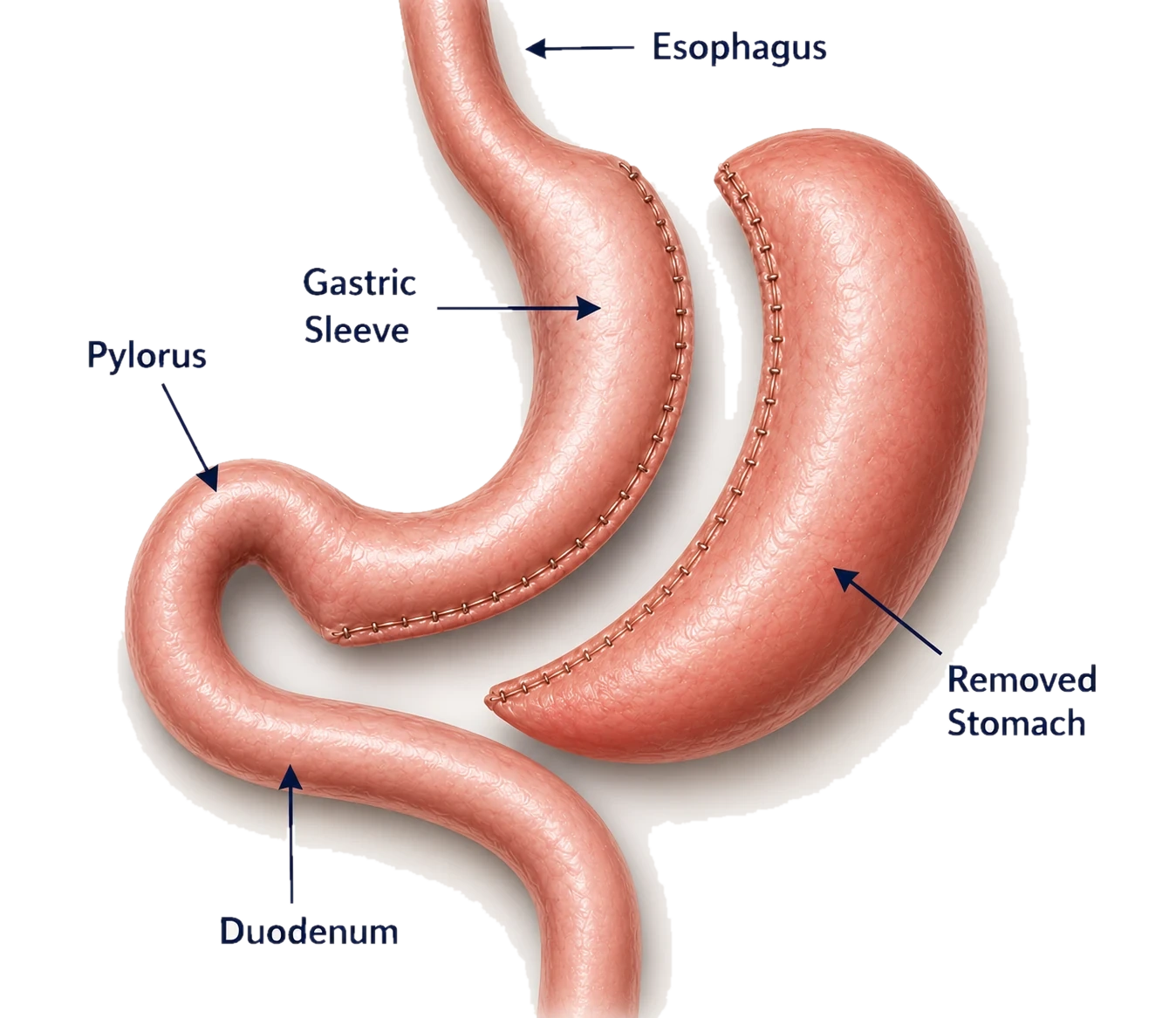
The gastric sleeve, or vertical sleeve gastrectomy (VSG), is a weight loss procedure in which about 80% of the stomach is permanently removed, leaving a narrow, banana-shaped sleeve. It's the most commonly performed bariatric procedure in the U.S., it limits how much you can eat and lowers hunger hormones, without rerouting the intestine.
How it's performed
Dr. Eduardo performs the sleeve laparoscopically or with da Vinci robotic assistance, through a few small incisions rather than one large one. The outer portion of the stomach is removed and the remaining sleeve is sealed with a surgical staple line. Most operations take about 60–90 minutes.
How it causes weight loss
Two mechanisms work together: the smaller stomach restricts how much you can eat, and removing the upper stomach reduces ghrelin, the primary hunger hormone, so you feel full sooner and hungry less often.
Who qualifies?
Candidates generally have a BMI of 40 or higher, or 35 or higher with an obesity-related condition such as type 2 diabetes, sleep apnea or hypertension. The sleeve is often preferred for patients who want a simpler procedure without intestinal rerouting. Check full candidacy →
Expected results
Published data shows roughly 65–75% excess weight loss in the first year, with most weight lost over 12–18 months, and obesity-related conditions improving in a majority of patients. Individual results vary and depend on follow-up and lifestyle.
Risks & considerations
Risks include bleeding, infection, blood clots, staple-line leak, and new or worsening acid reflux. The risk of death is about 0.1%, and the risk of any complication is about 4%, varying by procedure and by your own health (ASMBS, 2025). Dr. Eduardo reviews your individual risk profile before surgery.
Recovery
Most patients go home the day after surgery and return to desk work within 1–2 weeks. You'll progress through a staged diet over 6–8 weeks. See the hub for the recovery overview →
Dr. Eduardo's approach
Fellowship-trained, robotic-assisted
As a board-certified, FASMBS, fellowship-trained surgeon, Dr. Eduardo performs the sleeve with advanced laparoscopic and da Vinci robotic technique, and, because he's also a foregut surgeon, he can assess reflux and a hiatal hernia at the same time. If reflux is significant, he'll discuss whether a bypass is the better fit. And if you develop reflux after a gastric sleeve, the same surgeon can evaluate and fix it. One practice, one surgeon, every step.
FAQ
Gastric sleeve FAQ
Can't find your answer here? Call us at (470) 742-1832 or book a consultation, we'll answer every question before you commit to anything.
The sleeve works two ways: it removes about 80% of the stomach so you feel full on much less food, and it reduces production of ghrelin, the main hunger hormone, so you feel less hungry overall. Together these restrict intake and curb appetite, driving steady weight loss. Individual results vary.
Published data shows roughly 65–75% of excess body weight lost in the first year, with most weight lost over 12–18 months. Long-term success depends heavily on follow-up, nutrition and lifestyle. Individual results vary.
No. Because the sleeve permanently removes part of the stomach; it cannot be reversed. It can, however, be revised, for example, converted to a gastric bypass if a patient develops severe reflux or experiences significant weight regain. Dr. Eduardo specializes in these revisions.
As with any major surgery, risks include bleeding, infection, blood clots, and (specific to the sleeve) staple-line leak and new or worsening acid reflux. The risk of death is about 0.1%, and the risk of any complication is about 4%, varying by procedure and by your own health (ASMBS, 2025). Dr. Eduardo reviews your individual risk profile before surgery.
Most patients go home the day after surgery and return to desk work within 1–2 weeks, with full activity by 4–6 weeks. You'll follow a staged diet (liquids, then puree, then soft, then solids) over the first 6–8 weeks. See our recovery timeline for details.
Start your journey
Is the gastric sleeve right for you?
Book a consultation with Dr. Eduardo for an objective evaluation and a straight recommendation.