Advanced metabolic procedures · Newnan, GA
SADI-S & the duodenal switch.
Two related but distinct operations that deliver the strongest metabolic results in bariatric surgery, reserved for higher-BMI patients or severe metabolic disease, and performed by a fellowship-trained surgeon.
Medically reviewed by Dr. Roger Eduardo, MD, FASMBS, Board-Certified General Surgeon. Last reviewed August 2026.
Book a consultation →Related, but not the same operation
SADI-S and the duodenal switch are often grouped together, and for good reason: both begin with a sleeve gastrectomy and both add an intestinal bypass to drive powerful, durable weight loss and metabolic change. But they are constructed differently. The difference comes down to how the intestine is reconnected: one connection or two, and that single design choice changes the complexity, the risk profile and the intensity of the nutrition that follows. Below, each procedure is covered on its own.
At a glance
SADI-S vs. duodenal switch
| SADI-S | Duodenal switch (BPD/DS) | |
|---|---|---|
| Intestinal connections | One anastomosis (single connection) | Two anastomoses (Roux-en-Y) |
| Technical complexity | Simpler; shorter operative time; fewer leak points | More complex; the most technically demanding of the two |
| Internal hernia risk | Lower: no Roux-limb mesenteric defect to close | Present: mesenteric defects are closed at surgery |
| Malabsorption / nutrition demand | Strong, but slightly less than classic DS | The strongest: the most intensive lifelong supplementation |
| Expected excess weight loss | ~75–85% | ~75–85%, typically at the top of the range |
| Best suited to | Higher BMI / severe metabolic disease wanting a simpler single-anastomosis option | The highest BMI or most severe metabolic disease needing maximum effect |
Both preserve the pyloric valve (unlike gastric bypass), which helps limit dumping syndrome. Which procedure fits you is a clinical decision Dr. Eduardo makes after a full evaluation.
Procedure 1
SADI-S
Single-anastomosis duodeno-ileal bypass with sleeve
What it is
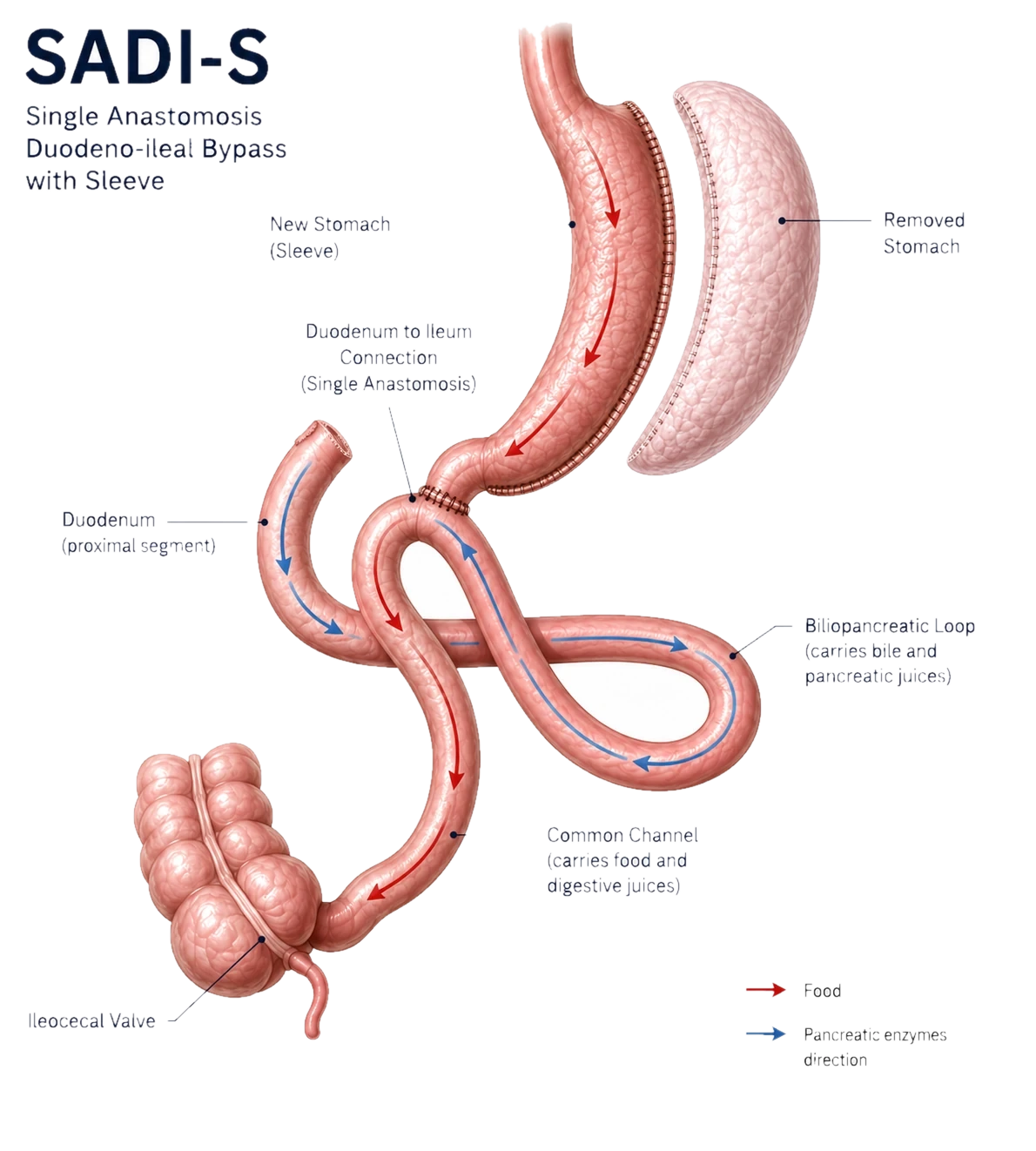
SADI-S is the newer, single-anastomosis evolution of the duodenal switch. Dr. Eduardo first performs a sleeve gastrectomy to reduce the stomach, then divides the duodenum just past the pylorus and reconnects it to a single loop of the ileum: one intestinal connection. Food and digestive juices travel together through a long common channel before absorption.
Why a surgeon may choose it
- ▪One connection means a simpler, shorter operation with fewer places that can leak.
- ▪No Roux limb, so there is no mesenteric defect to close, lowering the long-term risk of internal hernia.
- ▪Strong, durable weight loss and diabetes improvement, endorsed by the ASMBS as a recognized procedure since 2020.
- ▪Preserves the pylorus, which helps limit dumping syndrome.
Who it suits
Patients with a higher BMI or significant metabolic disease who want the power of a duodenal switch with a technically simpler, single-anastomosis construction. It still requires lifelong vitamin and protein supplementation.
Procedure 2
Duodenal switch
Biliopancreatic diversion with duodenal switch (BPD/DS)
What it is
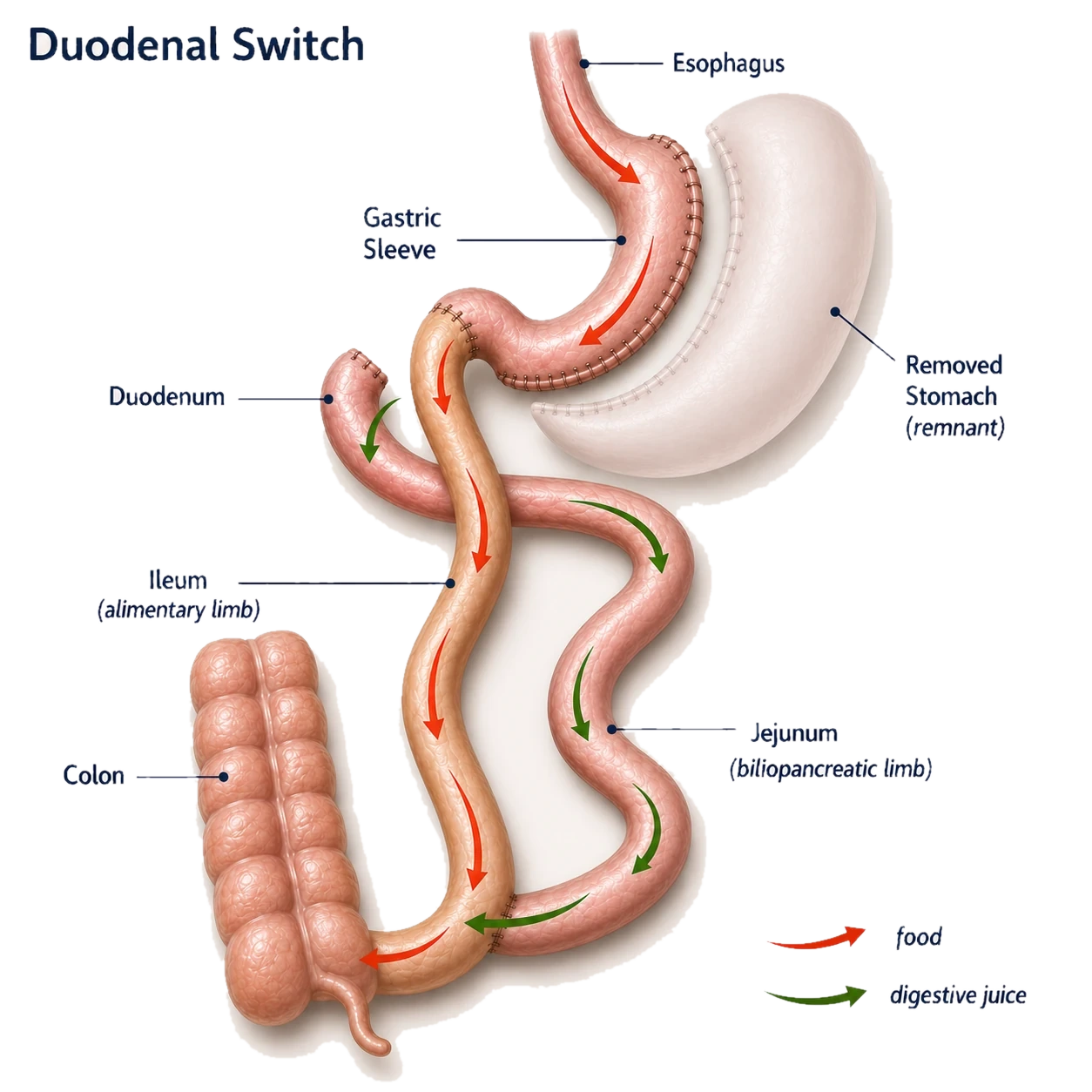
The traditional duodenal switch is the original (and most powerful) of the two. After the sleeve gastrectomy, the intestine is divided and reconnected with two connections in a Roux-en-Y configuration: an alimentary limb that carries food and a biliopancreatic limb that carries digestive juices, which meet at a defined common channel late in the small intestine. Keeping food and enzymes apart until that point is what produces its exceptional metabolic effect.
Why a surgeon may choose it
- ▪The strongest weight loss and diabetes remission of any standard bariatric procedure.
- ▪A long track record for the highest-BMI patients and the most severe metabolic disease.
- ▪Preserves the pylorus, which helps limit dumping syndrome.
The trade-off
That power comes from the greatest malabsorption of any common procedure, so it carries the highest risk of protein and fat-soluble vitamin (A, D, E, K) deficiency and demands the most disciplined lifelong supplementation and monitoring. The two connections also make it more technically demanding, and mesenteric defects are closed to guard against internal hernia. Dr. Eduardo reserves it for the patients who stand to benefit most.
Which one is right for you?
It is a clinical decision, not a menu choice. Dr. Eduardo weighs your BMI, metabolic disease, prior surgery, reflux status and how much lifelong supplementation is realistic for you before recommending SADI-S, the duodenal switch, or a different procedure entirely. Check full candidacy →
Shared ground
Both are advanced, sleeve-plus-bypass procedures that produce the strongest results in bariatric surgery, both preserve the pylorus, and both are typically reserved for a higher BMI (often 50 or above) or severe metabolic disease. Not everyone is a candidate for either.
Risks & considerations
Because both reroute the intestine, they carry a higher risk of vitamin, mineral and protein deficiency than a sleeve or bypass and require strict lifelong supplementation and monitoring, alongside the general surgical risks of bleeding, infection, clots and leak. The classic duodenal switch is the more malabsorptive of the two.
Recovery
A short hospital stay and a staged diet, broadly similar to other bariatric procedures, but with more intensive nutritional follow-up, most of all after a duodenal switch. Lifelong vitamin and protein monitoring is essential. See the recovery overview →
Advanced options, carefully chosen
Reserved for the patients who need them most
SADI-S and the duodenal switch are the most powerful metabolic procedures in bariatric surgery, but their malabsorptive effect demands disciplined lifelong nutrition. Dr. Eduardo recommends them only after thorough evaluation (for higher-BMI patients or severe metabolic disease where a sleeve or bypass alone falls short) and supports you with intensive, ongoing follow-up.
FAQ
SADI-S & duodenal switch FAQ
Can't find your answer here? Call us at (470) 742-1832 or book a consultation, we'll answer every question before you commit to anything.
Both start with a sleeve gastrectomy and add an intestinal bypass, but they are built differently. The traditional duodenal switch (BPD/DS) uses two intestinal connections (a Roux-en-Y with a defined common channel); SADI-S uses a single connection. That one difference makes SADI-S technically simpler, with fewer places that can leak and no Roux-limb mesenteric defect to close, while the classic duodenal switch remains the most powerful (and most malabsorptive) of the two. Dr. Eduardo recommends the right one for your case.
SADI-S is the newer of the two and was endorsed by the ASMBS as a recognized (no longer investigational) procedure in 2020. Its single anastomosis means a shorter operation and fewer connection points, which can lower certain risks such as internal hernia. It is not automatically 'better'. The classic duodenal switch still produces the strongest metabolic results for the highest-BMI patients. The right choice depends on your anatomy, BMI and metabolic disease.
Both the duodenal switch and SADI-S produce the strongest excess weight loss and metabolic improvement of the common bariatric procedures. Published data supports roughly 75–85% excess weight loss, which is why they're reserved for higher-BMI patients or severe metabolic disease. The classic duodenal switch tends to sit at the top of that range. Individual results vary.
These procedures are typically reserved for patients with a higher BMI (often 50 or above) or severe metabolic disease such as poorly controlled type 2 diabetes, where a sleeve or bypass alone may be insufficient. Not all patients are candidates. A thorough evaluation with Dr. Eduardo determines which one, if either, is the right fit.
Because both reroute the intestine, they carry a higher risk of vitamin, mineral and protein deficiencies than a sleeve or bypass and require strict lifelong supplementation and follow-up. The classic duodenal switch is the more malabsorptive of the two, so its nutritional demands are the most intensive. Dr. Eduardo reviews this carefully before recommending either procedure.
Start your journey
Is SADI-S or the duodenal switch right for you?
Book a consultation with Dr. Eduardo for a careful evaluation and a straight recommendation.